
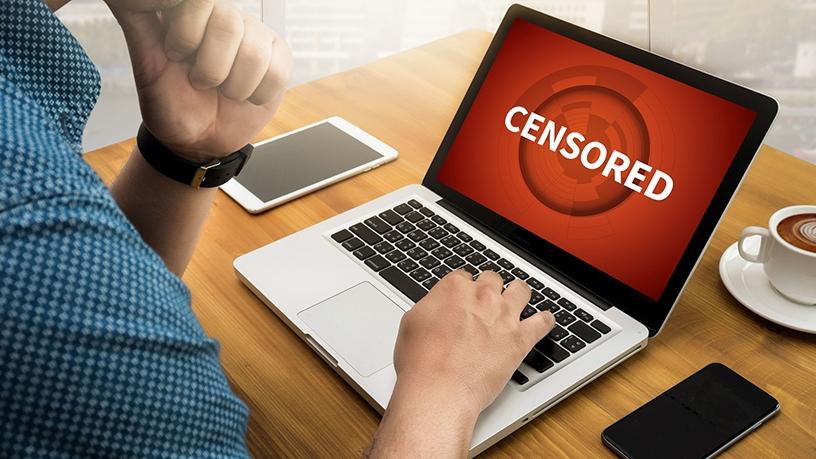
10-10-2026: The Australian government is slowly banning the internet. In the process, Australia’s ruling elite is further and further restricting free speech. Two years ago, the Australian Labor Party (ALP) federal government had to abandon its efforts to pass the Communications Legislation Amendment (Combatting Misinformation and Disinformation) Bill 2024 after it was narrowly defeated in the Senate following opposition from cross bench Senators, the Greens and the Liberal/National Coalition. This Bill would have effectively set up a “Ministry of Truth” where the politicians effectively had the power to delete debate on ideas they deemed to be “misinformation or disinformation”. That Bill was not supported by the federal government funded Australian Human Rights Commission (AHRC). The AHRC stated that information which is opportunistically labelled as “misinformation” or “disinformation” can delegitimise alternative opinions and limit open discussion about ideas of public importance.[1] It was also opposed by the Australian Catholic Bishops conference who held grave concerns that religious views could be viewed by some in power as “misinformation” and potentially be suppressed.
Online “Safety”
Some are now suggesting that in response to the defeat of the “misinformation” Bill, the federal government is now trying effectively the same thing with its Online Safety Amendment (Digital Duty of Care) Bill 2026. This bill introduces a legal obligation for online services to identify and reduce “foreseeable harm” to users, and effectively remove content from their platforms, whether a website or social media. Platforms that fail to do so could face penalties of up to $109.2 million, enforced by the so-called eSafety Commissioner. The bill would also require platforms to shield users under the age of 18 from material including pornography, content promoting eating disorders and content glorifying crime. No less than the US Embassy in Canberra has issued a formal submission expressing serious concern about the bill. For example, the US Embassy raised concerns over how the Communications Minister would define “foreseeable harm”, warning that vague outlines would push platforms toward “pre-emptive censorship” to avoid crippling fines.[2]
Though the US Embassy staff are far from radicals, they are correct to point to warn against “viewpoint censorship” where social media platform could be obliged to take down even slightly controversial views or speech, or risk bankruptcy. In a world now where the internet has effectively replaced the town square, such moves are a blatant suppression of free speech. The US Embassy are not champions of free speech for all, as they merely requested an exemption for US based tech companies. Australian Prime Minister Anthony Albanese claimed that the Online Safety bill is not about government control, but about giving people control over what content they receive on their devices.[3] This is misleading at the least, and it sounds like a line to assuage a sceptical public that they are not being censored. The federal government has already effectively banned those aged under 16 from social media use, as of December 10, 2025.[4] Even though some savvy youths have been able to get around restrictions so far, the bans effectively prevent young people from creating and maintaining an account on social media sites.
Breach of rights
None of these moves are about “safety” or “preventing harm” to children or adults. Reasonable people would not object to some measures to make it more difficult for children to access hard core pornography or videos of serious criminal activity. Yet this is transparently not what the government means by “online safety”. It is much more to do with curbing or blocking views and positions which flatly contradict those of the government, as the contradictions in a society based on extreme inequality become more and more glaring. Moreover, the actions of banning children from social media flatly breach pacts such as the United Nations (UN) Convention on the Rights of a Child. For adults, the “online safety” measures blatantly interfere with the basic right to political (and other) communication. The government seems to be concerned with children accessing political viewpoints on major issues that contradict theirs and are moving to prevent adults from criticising the government anonymously online. The age verification obligations that are already in place on many websites, are not primarily a means to check if users are over 16 or 18. It is a means, or is an attempt, of tracking the identity of every user of the internet.
In a submission in response to the Online Safety Act, Digital Rights Watch wrote that “age verification creates significant privacy and digital security risks that represent a disproportionate human rights infringement when balanced against the purported benefits”.[5] In other words, privacy and the human rights of users of the internet are systematically violated by so-called age verification. The government and its intelligence agencies can use measures such as age verification to identify visitors to a website and users of social media. The state then does not have to have thousands of security agencies tracking the activity of the masses online. Rather, their identities can be found through a simple search. Digital Rights Watch also raised serious concerns that the powers of the eSafety Commissioner – an unelected bureaucratic appointment, currently paid around half a million dollars in taxpayers’ money per year – are continually expanded far beyond what might be considered reasonable. For example, the eSafety Commissioner is effectively being handed the power to censor content on the internet.
Access to the internet which is not unreasonably restricted is a basic human right that cannot be allowed to be undermined. Reasonable measures to prevent serious crimes being posted online are not opposed, but there must be a way to discuss and debate issues online, on social media and elsewhere. The central aspects of the Covid era, where elementary democratic and human rights were ignored and/or suppressed with farcical justifications, should never be repeated. However, this may be what is in store, given that the Australian regime is following the US into a war on Iran, a war on Russia via Ukraine, and major preparations for a kinetic war with China. The longer capitalism exists, the more repressive the capitalist state must become. Millions of people can see that this system is no longer functional and are potentially forming radical conclusions. Democracy cannot exist across different classes, hence the need for the vast expansion of democratic rights via a workers’ state – the first crucial step towards socialism.
Workers League
www.redfireonline.com
E: workersleague@protonmail.com
[1] www.hrla.org.au/a_win_for_free_speech_as_misinformation_and_disinformation_bill_abandoned (07-10-2026)
[2] www.sofx.com/us-embassy-blasts-australian-online-safety-bill-as-viewpoint-censorship/ (07-10-2026)
[3] www.smh.com.au/politics/federal/what-the-digital-duty-of-care-bill-means-for-you-20260908-p60vfb.html (07-10-2026)
[4] www.esafety.gov.au/about-us/industry-regulation/social-media-age-restrictions (07-10-2026)
[5] https://digitalrightswatch.org.au/2024/06/25/submission-review-online-safety-act/ (07-10-2026)
Image: http://www.idmmag.com

