
By Stu Winters
28-09-2026: El Niño is a naturally occurring cyclical climate phenomenon centred in the Pacific region which tends to reshape weather patterns around the world and temporarily boosts global temperatures.
This year’s so-called “super El Niño” has already entered record-breaking territory.
Sea surface temperatures in the tropical Pacific have already exceeded the previous daily record set in 2015.
The current El Niño event – which has been underway since June and is expected to last until next year – has been developing faster than any previous event on record.
The strength of a “Niño event is tracked using the “Niño 3.4 anomaly”, which measures how much warmer sea surface temperatures in a section of the central Pacific are than average. As of late September of 2026, the daily anomaly in the “Niño 3.4” region stands at 3.11C, surpassing the previous record of 3.08C.
El Niño typically peaks in the winter months, most commonly in November or December.
Based upon past events and current trajectories there is every reason to think that this Niño will continue to strengthen.
For this year’s event, the Niño 3.4 anomaly has now reached 3.11C, breaking the previous record from 18 November 2015.
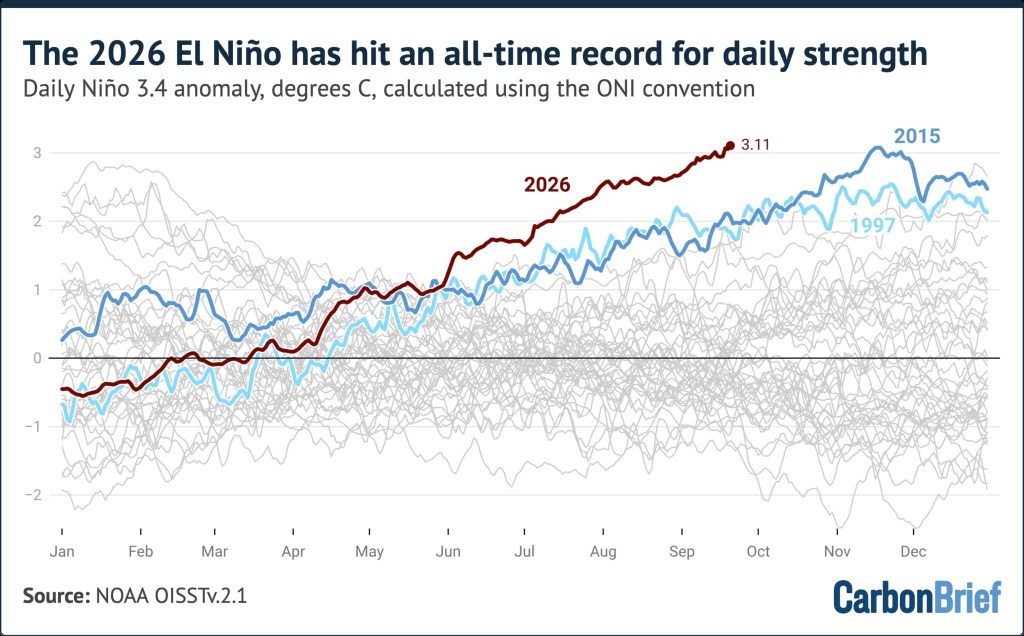
Daily Niño 3.4 sea surface temperature anomalies, from 1982 to 2026 (up to 21 September), each relative to a centred 30-year climatology (ONI convention). Chart by Carbon Brief.
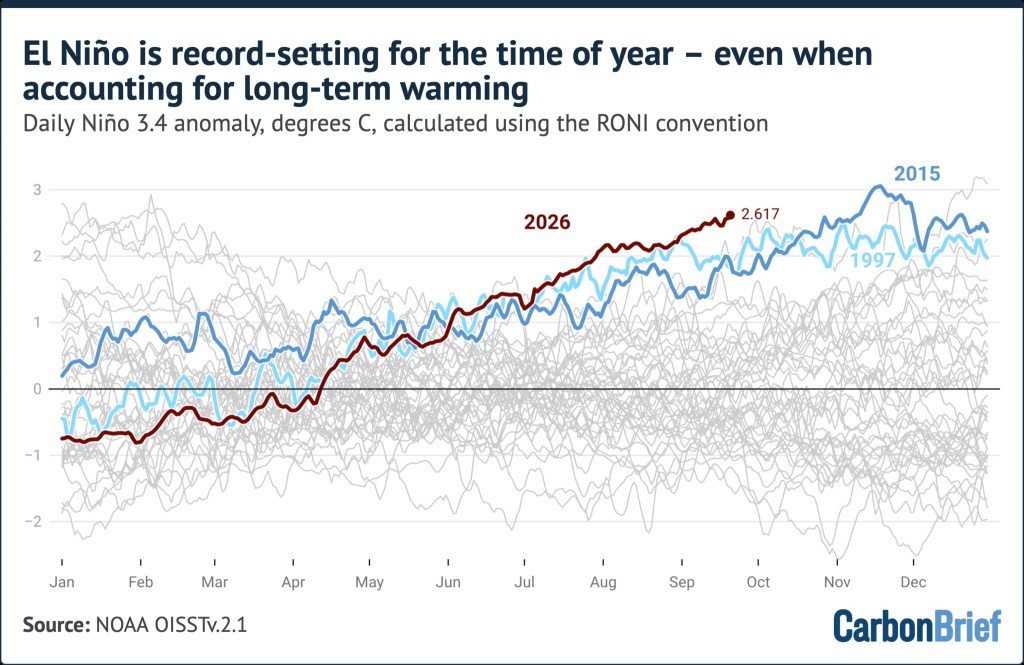
To analyse the developing El Niño, scientists generally follow the convention of the US National Oceanic and Atmospheric Administration’s (NOAA) Oceanic Niño index (ONI).
According to NOAA:
“ONI is calculated by subtracting the latest 30-year average temperature in the Nino 3.4 region from daily sea surface temperatures. This approach allows for the most recent years to be compared against the most recent 30-year period. It removes much of the influence of longer-term, human-driven warming from the index.” (emphasis added)
Since the start of June, El Niño’s strength has been greater than any other year on record. In early September in both 1997 and 2015, anomalies were around 1.9C – more than one degree below where they are this year so far.
It is worth noting that no seasonal forecast system has ever been verified against an event of this size, because none has ever occurred.
Typically all strong El Niño events on record have continued to strengthen well into the winter – and the models are in near-unanimous agreement that this one will, too. If the forecast holds, the current event will peak between November and January at a level far beyond any event previously observed in the instrumental record.
El Nino’s effect on global temperatures typically lags rising ocean temperatures in the Pacific by several months, so most of the impact will be felt in 2027 rather than 2026.
However, the El Niño currently heating up the planet has burst through the highest temperature ever recorded for the phenomenon, several months before its expected peak.
The most recent forecasts predict a peak of 4.0C in November and December, according to the average of 14 different models studied by climate scientist Zeke Hausfather who called it “mind-blowing”, Any temperature rise above 0.5C is deemed an El Niño; above 2C is officially called a “very strong” El Niño – often referred to as a “super” El Niño.
Heating up of the planet caused primarily as a result of fossil fuel burning is already causative of extreme weather and causing various episodes of human disasters, including melting of ice and flooding as seen during the recent Nepal flooding disaster, the full impact of which in terms of human casualties is still unknown.
This “Super El Niño” will likely increase climate destabilisation even more dramatically, and has already begun to affect regions across the planet as weather patterns are altered.
Prof Friederike Otto, at Imperial College London, said: “This event is a huge redistribution of energy in the climate system and is dangerous because it is unfolding on top of a much warmer, human-influenced climate system.
“So, in many places around the world we will see never-before-experienced heat extremes, with all their consequences on health, food security and water stress,” she said. “El Niño comes and goes, but as long as we continue to burn fossil fuels it occurs on an increasingly hotter baseline, making it much more difficult for communities to deal with the consequences.”
The UN World Meteorological Organization said it has launched the biggest mobilisation in its 50-year history to support national weather services to deliver “life-saving” forecasts.
“All effects from El Niño are magnified by global climate change,” said Prof Kevin Trenberth, at the National Center of Atmospheric Research in the US. “The northern summer of excess heat and wildfires in Europe, North America and Asia are but a sample of what is to come.”
All this is occurring while western leaders remain subservient to the fossil fuel industries which preclude any effective action to forestall extreme climate change.
President of the US Donald Trump has even gone so far as to call climate change a “hoax”.
In the final analysis, capitalism is leading humanity to the brink of disaster because of its inability to execute any sort of rational planning of energy usage while being wedded to endless profits derived from fossil fuels.
Only a socialist system has any hope for precluding – and hopefully minimising – the disastrous future humanity is facing.
Much of this information is derived from:
Readers should reference that link for further details.
Workers League
http://www.redfireonline.com
E: workersleague@protonmail.com

