
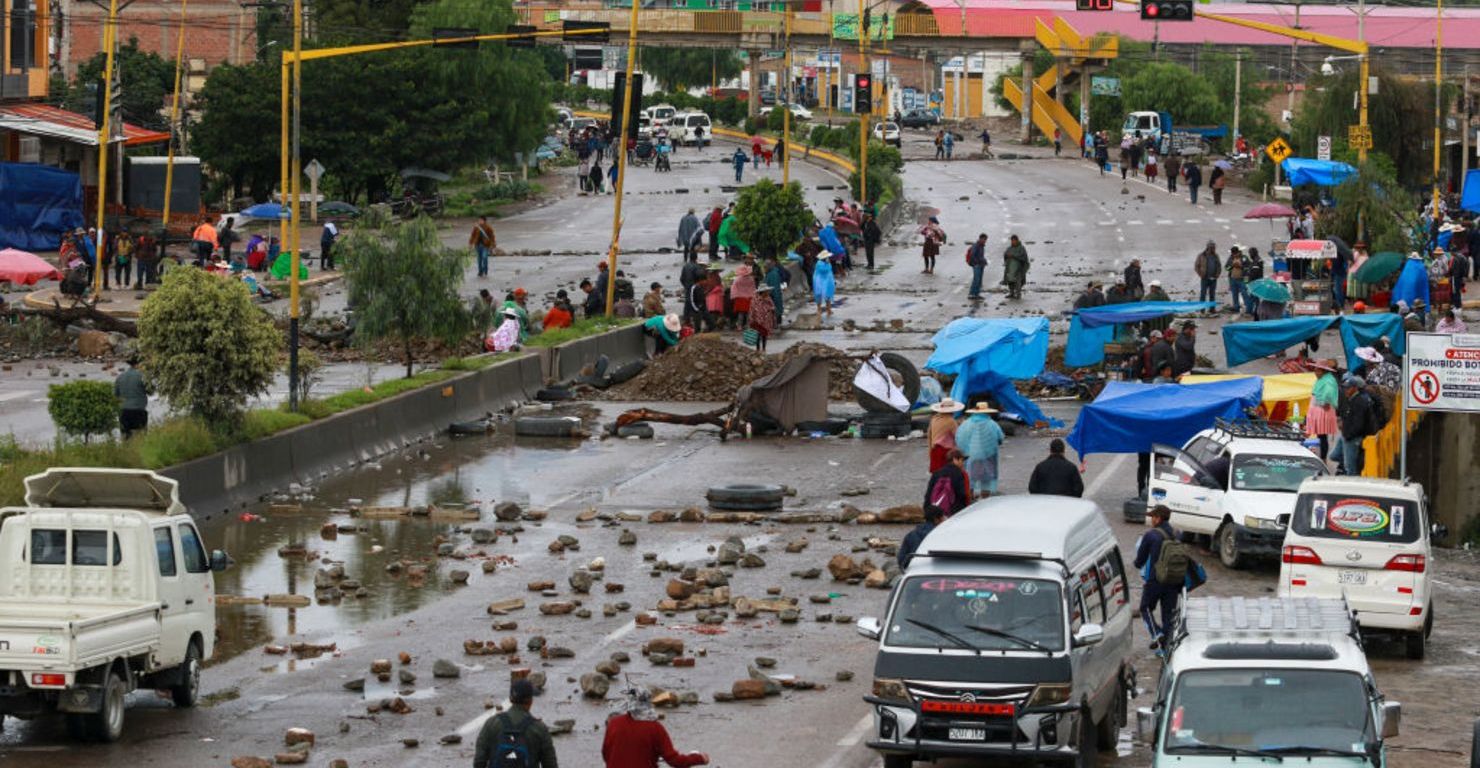
06-06-2026: During May, the Andean nation of Bolivia was gripped by weeks of a declared general strike, protest marches and road blockades in a seeming effort to topple the government of Rodrigo Paz. Only being elected six months ago, the conservative Paz government has moved ahead with neoliberal measures after almost 20 years of the left-wing Movement Towards Socialism (MAS) holding power, first led by Evo Morales and then Luis Arce. While Paz has not been able to start a program of privatisation, in January his government announced a move to eliminate fuel subsidies, leading to gasoline and diesel price hikes of up to 160%. Weeks of protests and road blockades took place at that time, which ended with an agreement that the government would repeal Supreme Decree 5503.[1] The actions were led by the Bolivian Workers Central (COB) Union and several indigenous peasant federations.
Land question
Then in March, more protests resulted from groups of farmers who opposed the controversial Law 1720. The law sought to convert land into a financial asset for granting loans, which would eliminate the exemption from seizure – based on the principle that land should not be taken away from a small or medium sized farmer.[2] Protesting against what they saw as land commodification in the interests of large corporations, thousands of farmers, indigenous people and others undertook a march of 1000 kilometres to the capital La Paz. This act forced the government at that time to shelve the “reform”. The 20 years of the MAS party pushing “Andean socialism” has had a positive political impact on the awareness and necessity to combat the ravages of capitalism in Latin America. This remains the case despite the fact that MAS’s project is not one of actual socialism, that is, the preparation for the raising of the working class to a position where workers democratically administer their own state. In one sense, the fact that MAS did not have such a perspective may have led to Morales being forced from government in 2019, and years later, the election of the conservative and neoliberal Paz administration.
However, at the start of May, there began calls for the resignation of Rodrigo Paz, and the re-starting of road blockades at vital points across the country. The COB and the La Paz Peasant Federation began to demand the President’s resignation, arguing that he has failed to resolve the political and economic crisis facing the country.[3] By May 6, there were 64 active road and highway blockades across Bolivia, including in Beni, La Paz, Santa Cruz, Cochabamba, Chuquisaca, Tarija, Potosi and Oruro, with Pando the only department without active points.[4] Border crossings were also cut to Argentina, Chile and Peru. The blockades are more or less total, where protestors place large rocks across the roads in several lines, which does not allow any passenger or commercial traffic to pass. The state airline, Boliviana de Aviacion, announced air flights between La Paz and Cochabamba to assist passengers affected by the road blockades led by supporters of former President Evo Morales.[5]
Covert Regime Change Operation?
The question arises, however, are road blockades a form of protest, or do they have another aim? The road blockades block food, fuel and oxygen supplies (important in the high altitudes of the Andes) from reaching everyone, even those supportive of the protest. In any uprising or revolution, road checkpoints may well be established by workers, in order to allow through supporters and block class enemies. Yet the road blockades in Bolivia block all traffic, even those carrying food and/or medical supplies. This has led to a situation where the government, attempting to open “humanitarian corridors” by using police and military personnel, can claim that they have the welfare of the people at heart. Minister Mauricio Zamora led one such convoy with the goal of clearing the critical highway linking the capital to Oruro to allow food, fuel and essential supplies to reach a city under siege. Zamora repeatedly called for dialogue with the protestors, but instead the convoy was attacked at multiple points along the route, often with sticks of dynamite.[6]
Rodrigo Paz has stated that he will make every effort to engage in dialogue with the social sectors maintaining the blockades but warned that “everything has a limit”.[7] It is perhaps understandable that protestors demanding the resignation of a President would refuse negotiations, but there appears to be another agenda. For example, looting by protestors has been reported taking place at the same time. The government released footage showing looters in La Paz making off with furniture, computers, monitors and other equipment.[8] Needless to say, looting of stores has little to do with a protest about anything, and raises more suspicion. This may be a consequence of a “leaderless” movement, where there appear to be no political parties taking part in the protests, or announcing their support for the blockades. A “leaderless” movement, from experience internationally, almost always means that US backed “NGOs”, which are actually government funded organisations – are the culprits.
Evo Morales had expelled the USAID (US Agency for International Development) from Bolivia in 2013,[9] but since then USAID has returned, along with projects funded by the European Commission.[10] The CIA regime change cutout the National Endowment for Democracy (NED) in its 2025 annual report, admits to funnelling almost a million dollars into the country, to “promote electoral transparency”. They are even more explicit and state that “..as China and Russia deepened its engagement in the region the NED helped citizens understand how this affects domestic governance and can erode national sovereignty”.[11] (!) The infamous Ford Foundation has also long been active in the Andean region.[12] The other infamous entity that works alongside the US State Department internationally – George Soros’ Open Society Foundation – has its claws in Bolivia also. In fact, Evo Morales reportedly at one point was questioned over getting support from Cuba and Venezuela, to which he replied, “I also get support from North American and European NGOs like the Open Society Foundation”.[13]
Washington moves against Latin America
Some claim that Bolivia today cannot be the site of a US backed regime change/colour revolution operation because the US government has voiced its full support for the Bolivian government, and have decried the blockades causing a humanitarian crisis.[14] Yet at the same time, the US government has kidnapped Venezuelan President Nicolas Maduro, and has arguably taken over what remains of its government. Washington is also strangling Cuba with an even stronger economic embargo than the one it kept in place for 66 years. With the US war on Iran floundering if not failing altogether, and the proxy war on Russia via Ukraine crumbling, it does appear as though US imperialism is tilting towards Latin America for some “wins”. In the cases of Venezuela, Cuba and Bolivia, the regime change methods Washington is employing is slightly different. Yet for them, they aim for the same outcome.
The link between Venezuela, Cuba and Bolivia is not just that they are Latin American neighbours and comrades in arms. They are also part of the rising multipolar world. Venezuela was next in line to join BRICS (Brazil, Russia, India, China, South Africa plus 15 other Global South states), the non-imperialist financial and economic bloc, before it was invaded. Cuba and Bolivia are both BRICS partner states, and are allies of the BRICS pillar states Iran, Russia and China. Everyone knows that the aging US Empire is preparing the ground for an improbable war against Red China, which is now virtually the world’s only industrial, manufacturing, scientific and technological superpower. A vital part of Washington’s preparation for this suicidal mission is the knocking out of China’s allies and partners one by one.
Workers need to “zoom out” and view the international situation to fully appreciate what is happening on the ground in Bolivia today. There is no doubt that there are some genuine and legitimate protests occurring against the government of Rodrigo Paz, and these should be supported. At the same time, there appears to be covertly organised violence being orchestrated in an attempt to create chaos and destabilisation – with the aim of regime change. These actions should be avoided by Bolivians, to avoid being unwittingly drawn into a nefarious political agenda they would be repelled from if it showed its face. This does not involve offering any political support for the Paz administration. However, Bolivian workers have a material interest in allying with the rising multipolar world and its Global South allies rather than a rapidly decaying US Empire and its multiple “soft power” agents. Real socialism can arise on the ashes of a rotting capitalism, provided workers unmask the operatives of the old world.
Workers League
www.redfireonline.com
E: workersleague@protonmail.com
[1] www.upi.com/Top_News/World-News/2026/01/13/latam-bolivia-protests-fuel-subsidy-agreement/5131768328432/ (03-06-2026)
[2] www.peoplesdispatch.org/2026/05/18/no-peace-for-paz-bolivian-movements-demand-president-resign/ (03-06-2026)
[3] www.cnnespanol.cnn.com/2026/05/17/latinoamerica/eeuu-respaldo-paz-bolivia-crisis-humanitaria-bloqueos-orix (03-06-2026)
[4] www.riotimesonline.com/bolivia-blockades-tupac-katari-paz-fuel-crisis-may-2026/ (03-02-2026)
[5] www.en.mercopress.com/2025/06/06/bolivia-boa-announces-solidarity-flights-amid-road-blockades (03-02-2026)
[6] www.latintimes.com/coup-that-calls-itself-protest-bolivias-crisis-enters-its-darkest-hour-597598 (03-06-2026)
[7] www.infobae.com/america/agencias/2026/05/23/paz-dice-que-extremara-esfuerzos-para-el-dialogo-en-bolivia-pero-todo-tiene-un-limite/ (03-06-2026)
[8] www.witness.co.za/news/2026/05/19/bolivia-protest-sees-violent-clashes-looting-in-la-paz/ (03-06-2026)
[9] www.cepr.net/publications/bolivia-expels-usaid-not-why-but-why-not-sooner/ (03-06-2026)
[10] www.esuivi.com/guides/understanding-usaid-funded-projects-in-bolivia-2026-me-standards-guide/ (03-06-2026)
[11] www.ned.org/wp-content/uploads/2026/02/2025-Annual-Report.pdf#page=43 (03-06-2026)
[12] www.fordfoundation.org/our-work-around-the-world/andean-region/ (03-06-2026)
[13] www.spectator.org/the-soros-footprint-in-latin-america/ (03-06-2026)
[14] www.x.com/WHAAsstSecty/status/2056086307517219233?s=20 (03-06-2026)
Image: One of the road blockades set up in Bolivia, which stops all traffic. http://www.cnnespanol.cnn.com

