
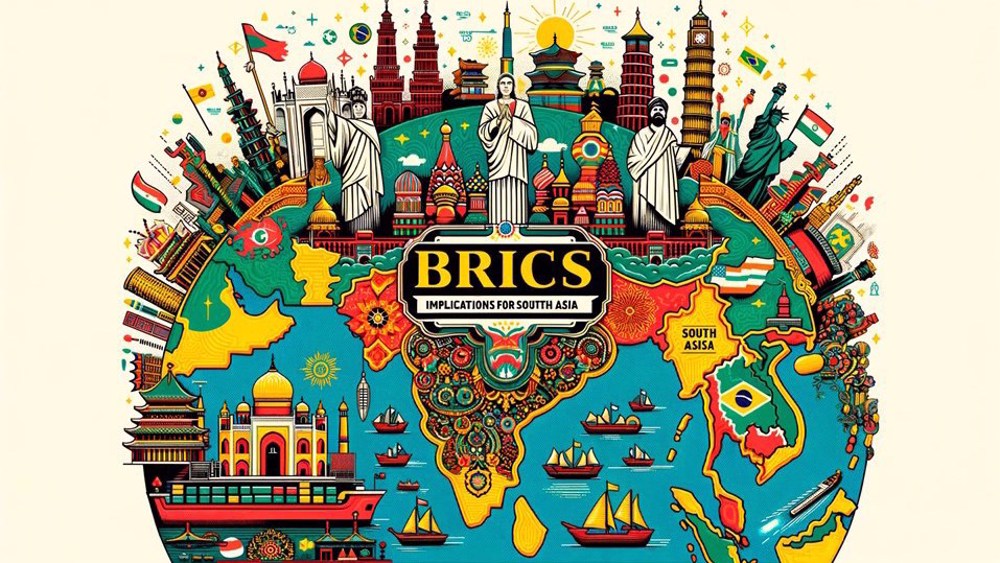

04-01-2025: The first of January 2025 saw another expansion of the BRICS economic-political alliance following on from its most successful summit in October 2024. The nine member BRICS bloc (Brazil, Russia, India, China, South Africa, Iran, Egypt, Ethiopia, United Arab Emirates) has now officially welcomed nine new partner nations, these being: Belarus, Bolivia, Cuba, Indonesia, Kazakhstan, Malaysia, Thailand, Uganda and Uzbekistan. The combined populations of the 18 nations that are either full members or partner members of BRICS is now approximately 4 billion people, or roughly half of the world’s population. Perhaps more impressive than this is the fact that the expanded BRICS as of 1 January 2025 now comprises 41% of global GDP (Gross Domestic Product) if measured in terms of purchasing power parity (PPP – the amount of goods and services than can be purchased with a given amount of money).[1] This could expand yet further, as the nations of Algeria, Nigeria, Türkiye and Vietnam were invited to become partner members, but are yet to give a formal response.
West tries to ignore BRICS
True to form, Western governments and its compliant corporate media have done their level best to ignore the significance of the BRICS bloc or claim that it is not of significant importance. Yet the reality is that the BRICS bloc is providing a vital counterweight to the Western dominated financial, economic and political order which emerged after World War II. Even before the most recent expansion of BRICS, the BRICS New Development Bank (NDB) was projecting that the BRICS would increase its cover to 40% by 2028 – but this has been achieved three years early. At the same time the combined global GDP from the G7 (the formerly rich, colonial and imperialist powers – the United States of America, the United Kingdom, Germany, France, Italy, Canada, Japan) had already dropped to 27.8%.[2] Capitalism in the West is on the decline, with several major European economies in or near a recession, while the major Eurasian economies (Russia, China, Iran) continue to rise in combination with each other, and via co-operation with the nations of the “Global South” (the nations of the developing world).
Ironically, it is the behaviour of the imperialist G7 powers themselves which has spurred the recent acceleration of the BRICS process. The US government in particular has levied sanctions on Russia, Iran and other nations deemed adversaries. At the October 2024 BRICS Summit, Iran’s President Masoud Pezeshkian said that illegal (Western) sanctions have a destructive impact on international relations and block access of countries to their own financial resources. He stated that a better world will be established “when there is no trace of sanctions, imposition of will, aggression, war, conquests and genocide”.[3] The governments supporting the BRICS process unanimously agree that multilateralism must prevail over unilateralism, that multipolarity must prevail over unipolarity, that there must be a general equality of nations and that this must be reflected in world governance. So even though the BRICS bloc is formally only an economic alliance, it has inevitably already spilled over into the vital areas of world politics and security, i.e., of the prevention of war. The relentless moves by Washington and their handful of allies against Russia, China, Iran are not at all supported, and in many cases are opposed, by many nations in the Global South, as it directly impedes their economic development.
BRICS to replace the UN, IMF?
The current direction of the BRICS is already raising the question of the supersession of the key institutions of the Western dominated world order. Already some analysts are suggesting that there should be a merger between the BRICS and the Shanghai Cooperation Organisation (SCO), as the events of the last five years have rendered the United Nations “rudderless”.[4] The SCO is more geared towards security issues and is largely led by the People’s Republic of China (PRC). It is true that the declaration of the BRICS Kazan Summit in October 2024 offers support for the role of the United Nations (UN), the World Health Organisation (WHO) and even the International Monetary Fund (IMF). But even the subtitle of the document is a hint of its trajectory: “Strengthening Multilateralism for Just Global Development and Security”.[5] If the BRICS is allowed to develop unhindered, even the very existence of its institutions will tend to lessen the importance of the Western dominated institutions which were set up to ensure the capitalist West remains in control. If there is an alternative available to a world dominated by the (former) colonial powers, the global majority will opt for that alternative.
The inclusion of Indonesia in BRICS could be a game changer for South East Asia. Indonesia is the world’s fourth most populous nation, and given its size, was a major part of ASEAN (Association of South East Asian Nations). Now, alongside Malaysia and Thailand also being BRICS partners, ASEAN itself may become redundant. ASEAN was originally established in 1967 as a pro-Western anti-socialist alliance to combat “communism” in the region. Ostensibly, ASEAN is about fostering economic development in South East Asia, but with the economic decline of the West besides the stupendous economic rise of the PRC, the BRICS bloc is clearly a more viable alternative. Indonesia has promoted solidarity with developing nations going back to the Bandung Conference of the 1950s, and its role as a BRICS partner and potential full member builds on this history.[6]
The rise of the BRICS and the crumbling of the G7 and its attendant UN and IMF are ultimately a reflection of the crisis of world capitalism in the face of the enormous industrial, manufacturing and technological power of the socialistic PRC and its alliances along with the active solidarity of the overwhelming majority of the Global South. To this extent, it is in the vital interests of working people the world over to defend the BRICS process, and to defend BRICS member states against economic, political and military provocations, sanctions, colour revolutions, regime change operations and proxy wars directed by Washington and its G7 allies. At the same time, the governments of the BRICS nations are not socialists, and will try in vain to hold imperialism at bay via endless dialogue. Imperialism cannot be bargained with, however, and can only be upended by “their own” working classes raising themselves to power, i.e., through revolution. A tactical orientation towards the BRICS bloc, while seeking to organise working people into Marxist vanguard parties for the vital political leadership required – is imperative. A better world is on offer with workers in power.
Workers League
www.redfireonline.com
E: workersleague@protonmail.com
[1] www.geopoliticaleconomy.com/2024/12/25/brics-expands-9-partner-countries-population-economy/ (01-01-2025
[2] www.tass.com/world/1745915 (01-01-2025)
[3] www.presstv.ir/Detail/2024/10/24/735889/Iran-Masoud-Pezeshkian-Russia-Kazan-BRICS-equation-balance-sanctions-unilateralism-human-rights-development-Israel-war-Gaza-Lebanon (01-01-2025)
[4] www.presstv.ir/Detail/2023/08/05/708412/BRICS-merger-SCO-Indian-expert (01-01-2025)
[5] www.static.kremlin.ru/media/events/files/en/RosOySvLzGaJtmx2wYFv0lN4NSPZploG.pdf (01-01-2025)
[6] www.msn.com/en-xl/news/other/indonesia-s-brics-bid-raises-questions-about-asean-s-future-under-prabowo/ar-AA1taSGk (01-01-2025)
Image: http://www.presstv.ir
 Red Fire
The BRICS countries all marched in lockstep during The Great Motherfuckery. I don’t see this as anything much more than a moving of head office and an appearance of forward movement
LikeLike
Certainly the *governments* of the BRICS nations went along with the Covid *narrative*, but who is advocating political support for such governments? Certainly not us. However, even with the implementation of Covid repression, the governments of the BRICS nations were inconsistent. For example, the PRC had some horrific lockdowns, but the government was never able to implement a vaccine mandate – as the Chinese masses knew that this would be flat out illegal. In Russia too, the government was not really able to impose vaccine mandates in many places, and lockdowns were limited also.
The BRICS *process* can potentially lead to a challenge to the floundering Western elites, but it does need some political leadership.
WL
LikeLike
I dunno, I wish I shared your enthusiasm. But who knows, I guess. The world is on an odd tilt these days, maybe anything’s becoming possible 🌼
LikeLike