
By Stu Winters
Permafrost is permanently frozen ground that remains at or below 0°C (32°F), the temperature at which water freezes, and which covers large sections of the earth’s polar and some high-altitude mountain regions. Its presence in the earth’s biological cycles serves to keep ancient carbon deposits, largely consisting of frozen vegetation and physical remains of other biological life forms, below the surface and therefore not circulating as carbon.
Much of the under-permafrost material has been segregated from the planetary carbon cycle for a long time.
On Earth, permafrost is estimated to hold about 1700 billion tons of carbon, roughly three times the amount currently present in the atmosphere!
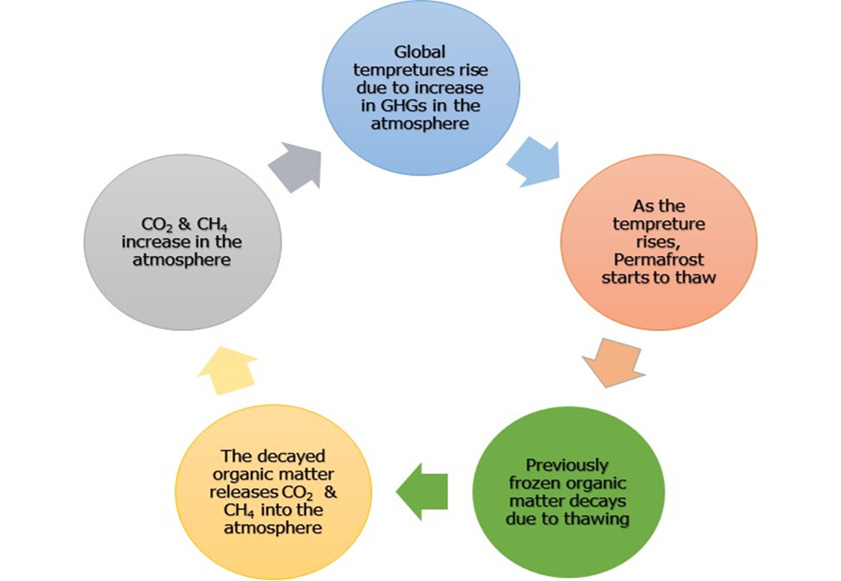
Experiments conducted by researchers at the University of Leeds, and published in the AGU journal Earth’s Future, show that when permafrost thaws, as it has been doing in increasing amounts on a warming earth, it becomes 25 to 100 times more permeable thus allowing significantly greater amounts of greenhouse gases and especially carbon to escape into the atmosphere resulting in a positive feedback loop of increased atmospheric warming driving increased release.
Professor Paul Glover, Chair of Petrophysics in the School of Earth, Environment and Sustainability at the University of Leeds, who led the research said: “It is now widely recognized that climate change is leading to significant thawing of permafrost, with a 42% expected loss of permafrost in the Arctic Circumpolar Permafrost Region (ACPR) by 2050.
Professor Glover noted that these findings represent early results, although they are being supported by ongoing measurements.
“The release of huge amounts of carbon that have been stored in previously frozen soils, predominantly in the Arctic, represents a very real danger, especially as it is known that climate change is warming the Arctic regions four times faster than elsewhere.
“The hypothesis that thawing of permafrost could release sufficient climate forcing gases not only to continue but to accelerate climate change is one step closer to being confirmed by the results we are publishing today.”
The study, carried out in Leeds’ Petrophysics Laboratory, examined how temperature changes influence both gas movement through computer-modelled permafrost and the quantity of gas released.
Using methods borrowed from energy science, researchers gradually increased temperatures from -18°C (0°F) to +5°C (41°F), measuring gas release at each step. The most significant increase in permeability occurred between -5°C (23°F) and 1°C (34°F). It appears significant that even at temperatures below the 0°C freezing point of water, notable permeability (and consequent carbon release) occurs.
Co-author of the study Dr Roger Clark, Senior Lecturer in the School of Earth, Environment and Sustainability at Leeds wrote:
“While these are significant results in themselves, showing how we are beginning to understand the mechanisms behind some aspects of climate change, they are also important because the measurements were only made possible by the adoption of methodologies previously developed for use predominantly by the fossil fuel industry.”
He also pointed out that the findings have implications beyond release of greenhouse gases. Thawing permafrost may also release radon, a potentially dangerous radioactive gas. Radon is often tested for in underground basements in certain geographical areas where its presence is easily ameliorated using efficient exhaust fans.
Reference: “Measurement of Gas Fraction and Gas Permeability of Thawing Permafrost Caused by Climate Change” by P. W. J. Glover, L. Tliba, R. A. Clark and P. Lorinczi, 24 March 2026, Earth’s Future.
Image: Positive feedback loop for thawing permafrost. http://www.earth.org
 Red Fire