
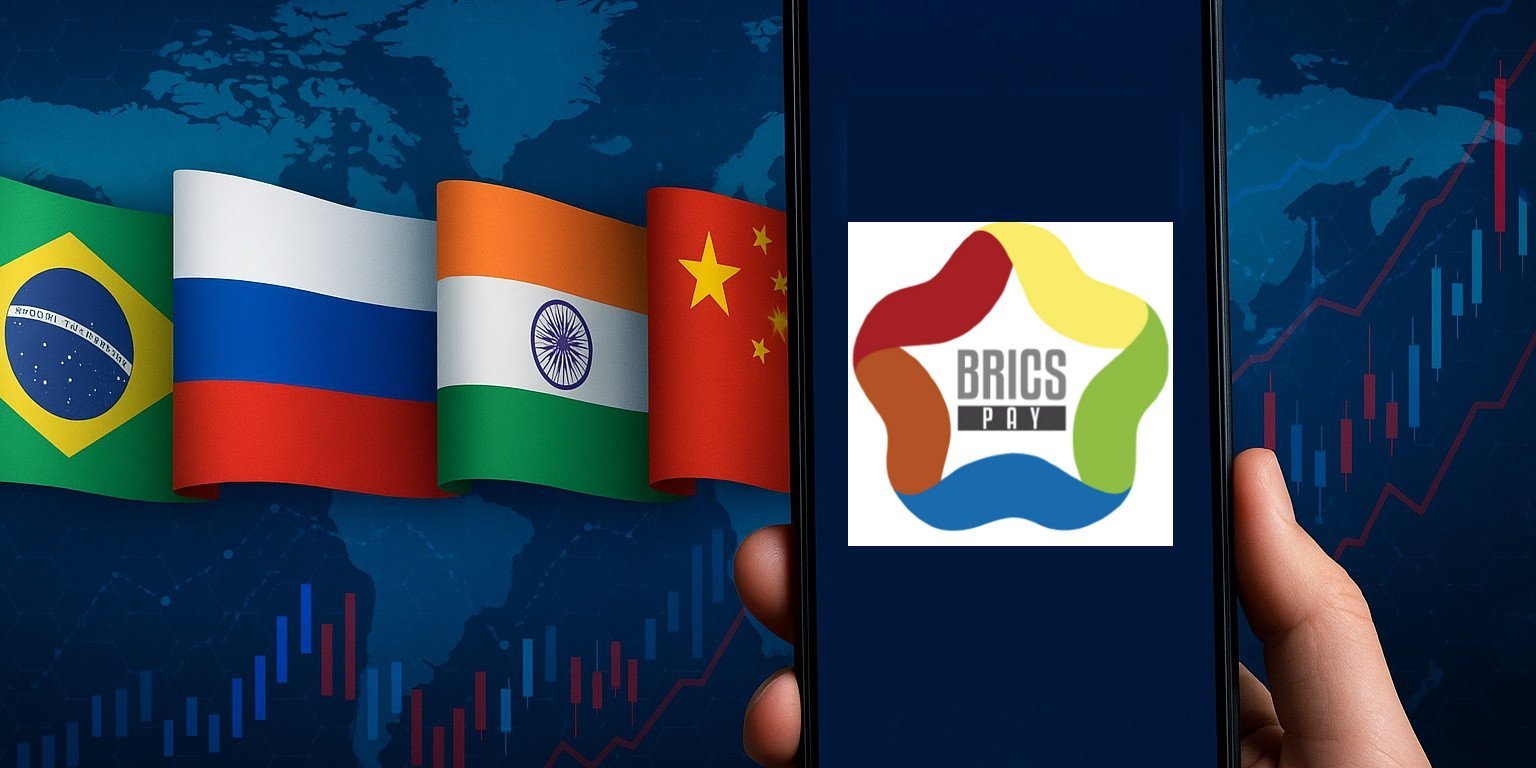
31-01-2026: Ever since World War II, the flow of global finance has largely been controlled by Western led institutions and the SWIFT (Society for Worldwide Interbank Financial Telecommunication) network, which connects over 11 000 banks in over 200 countries,[1] under the influence of the United States of America (US) and the main powers of the European Union (EU). However, in 2022, the Russian Federation was excluded from SWIFT by the West after it began its Special Military Operation (SMO) in response to the US/EU led proxy war via Ukraine. This act highlighted the vulnerability of Global South economies to the various forms of increasingly levied Western sanctions. In response, the BRICS nations (Brazil, Russia, India, China, South Africa plus 15 others) began to take steps to create a parallel financial infrastructure outside Western control. Already in 2014, BRICS had created the New Development Bank and the Contingent Reserve Arrangement (CRA) as first steps to provide an alternative to the notorious Western run International Monetary Fund (IMF) and the World Bank (WB).
Multipolar alternative
Now, BRICS Pay testing has been confirmed,[2] and its successful launch may herald the end, or at least the decline of SWIFT. BRICS Pay is a decentralised, interoperable payment platform designed to enable fast, secure and low cost cross-border transactions. The groundbreaking 2024 BRICS Summit in Kazan commissioned BRICS Pay, driven by a collective drive towards monetary multipolarity and reduced dependence on the US dollar.[3] Moreover, BRICS Pay can facilitate transactions directly between BRICS members which develops national currencies rather than forever strengthening the US dollar. BRICS Pay could be backed by the existing domestic infrastructure of BRICS members, such as Russia’s System for Transfer of Financial Messages (SPFS), China’s Cross-Border Interbank Payment System (CIPS), India’s Unified Payments Interface (UPI) and Brazil’s Pix system.[4] What is more, Russian Foreign Minister Sergei Lavrov confirmed last year that BRICS Pay will be available for use for countries that are NOT members of BRICS as soon as it is launched.[5]
The development of an independent or alternative financial system is a key aspect of the BRICS Bloc’s vision of a multipolar world, where power is not concentrated in the hands of a few (imperialist) nations but is more diffused among different regions. The World Bank and the International Monetary Fund (IMF) are all products of the post WWII Era. BRICS governments have long called for reform of these institutions to give developing countries a greater voice and more representation, in bodies such as the United Nations (UN).[6] However, BRICS Pay and the broader BRICS agenda may not reform the old order but provide a viable alternative to it. In the ruling circles of the West, this is perceived as nothing less than a challenge to the existing global order. Countries that face being targeted by Western sanctions could potentially use BRICS Pay and similar initiatives and thereby remain immune to the hostile economic moves of Washington, London and Brussels. One can see how imperialism is not amused!
BRICS Unit, BRICS Bridge
Yet BRICS Pay is just the start. Also in the pipeline is the BRICS Unit, a digital settlement currency, also formed as a response to increasing dissatisfaction with the US dollar-centric financial architecture. The Unit is not a traditional fiat currency like the US dollar, and nor is it a cryptocurrency. It is designed as a digital settlement instrument backed by a basket of assets to enable cross border trade and settlement. 40% is backed by physical gold, and 60% by national currencies such as the Brazilian Real, the Russian Ruble, the Indian Rupee, the Chinese Renminbi and the South African Rand. This model provides stability from gold’s value, diversification across major emerging market currencies, and resistance to domination by any single member country.[7] BRICS Pay and the BRICS Unit is not yet a coup against the US dollar, or at least for the moment. Yet this is the direction in which it is inexorably heading.
The BRICS Bridge project is an attempt to link BRICS central bank digital currencies (CBDC). For many countries in the Global South, especially in Africa, this is a credible route out of dollar dependency that has constrained growth, distorted trade and amplified every external shock. For decades, even transactions between neighbouring African states required dollar settlement through corresponding banks in New York or London, which drains reserves and inflates transaction costs. If BRICS Bridge is integrated with existing infrastructure such as the Pan-African Payment and Settlement System (PAPSS), India’s E-Rupee, China’s digital Yuan and African CBDCs such as the e-Naira – it would allow direct settlement between currencies.[8] Lower transaction costs lead to cheaper imports. Fuel, fertiliser, medicines and electronics sourced form BRICS partners would be less expensive. Dollar shortages, a problem for decades, would be much less of a problem, if one at all.
One does not need to be an expert in finance or economics to see how the BRICS financial infrastructure could benefit billions of people in the Global South, and even provide an alternative to those in the Global North. It is a dramatic expression of the fact that capitalism is facing a terminal decline, and the multipolar world is rising in its place. The BRICS governments do not intend to move towards a socialist economic system, and even the socialistic People’s Republic of China (PRC) has no intentions to assist other nations to move in that direction either. Despite this, rising multipolarity is a direct challenge to the very rule of imperialism, which has held sway over the globe for the past 500 years. While the multipolar world will not in itself lead to revolutions, the working people of the world will need to traverse through multipolarity and the joining of forces with the Global South in order to achieve socialism.
Imperialism is well aware of all of this, and its response is to wage nothing less than all out war on the BRICS bloc. The proxy war in Ukraine, regime change in Syria, the coming regime change war on Iran, the kidnapping of Venezuela’s President Maduro, the arming of Taiwan, using Israel to genocide Palestine, triggering multiple colour revolution attempts in Indonesia, Bangladesh, Nepal, Serbia and others – all of this and more are efforts to bring down multipolarity before it wins the allegiance of the world’s working people. Yet these destructive acts represent a weakening imperialism, tottering in the face of a rising alternative. The goal of the working class should be to forge Marxist vanguard parties to help guide the masses toward victory over private capital, and a new dawn of common prosperity.
Workers League
www.redfireonline.com
E: workersleague@protonmail.com
[1] www.bank-codes.com/countries (28-01-2026)
[2] www.youtube.com/shorts/G4FzH-C3BT0 (28-01-2026)
[3] www.insightsonindia.com/2025/11/05/brics-is-challenging-swift-building-a-multipolar-financial-architecture/ (28-01-2026)
[4] www.nextias.com/ca/editorial-analysis/06-11-2025/brics-challenging-swift-brics-pay (28-01-2026)
[5] www.cointribune.com/en/towards-the-end-of-swift-russia-announces-a-global-expansion-of-brics-pay/ (28-01-2026)
[6] www.bankinfobook.com/the-end-of-the-dollar-brics-pay-is-here-to-rewrite-the-rules-of-global-finance/ (28-01-2026)
[7] www.thelogicstick.com/unit-currency-what-it-is-how-it-works/ (28-01-2026)
[8] www.technext24.com/2026/01/20/brics-centralise-digital-currency-africa/ (28-01-2026)
Image: http://www.oroszhirek.hu
 Red Fire