
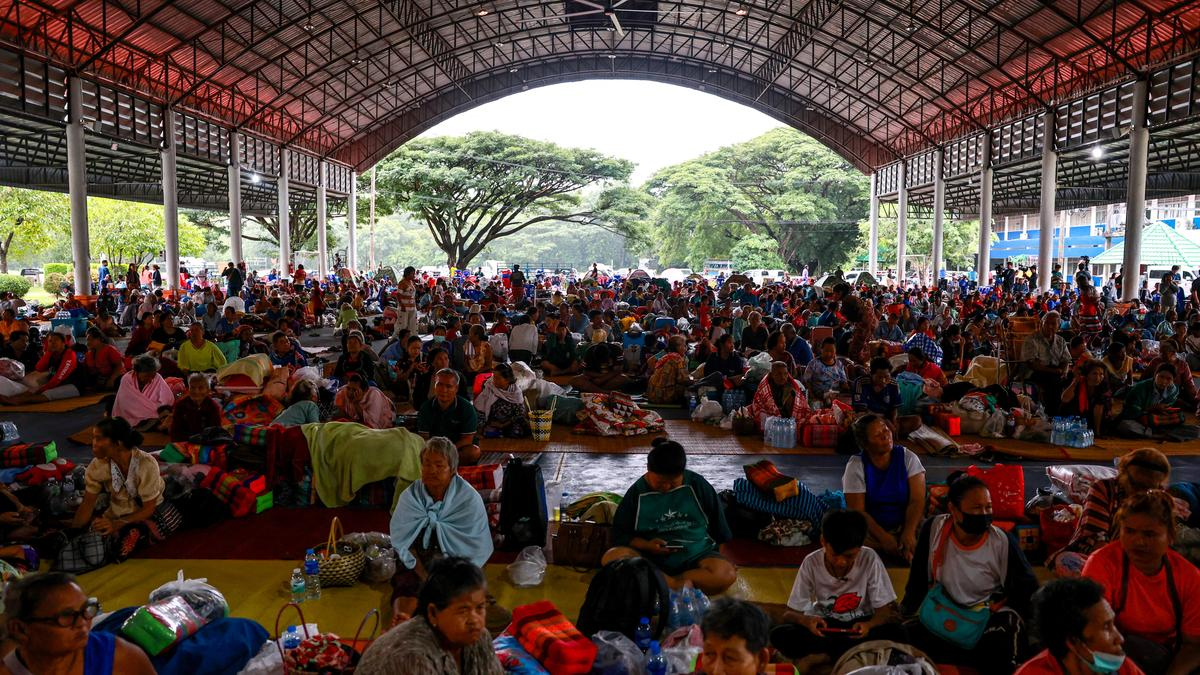
02-08-2025: A shaky ceasefire is currently in place between Cambodia and Thailand, after a period of heavy fighting and border clashes. The deadly skirmishes resulted in the deaths of 35 people and the displacement of around 200 000 residents. The agreement, which may not hold, was announced by the Prime Minister of Malaysia, Anwar Ibrahim, who led the mediation in the Malaysian city of Putrajaya.[1] By the 24th of July, it appeared that Cambodia and Thailand were edging closer to full scale war, as Cambodian forces launched unguided rocket attacks on neighbouring Thai locations, and Thailand responded with aerial strikes on Cambodian military camps. Cambodia and Thailand share a border which is 800 kilometres long. The contesting land claims stem from a 1907 map drawn up by the French colonial rulers which was used to separate Cambodia from Thailand. Cambodia uses the map to claim territory, while Thailand argues the map is inaccurate. In February, Cambodian troops and family members entered the ancient Preah Vihear temple in one of the disputed areas, leading to an argument with Thai troops. The International Court of Justice (ICJ) awarded sovereignty over the area to Cambodia in 1962, and reaffirmed this in 2013, much to the chagrin of Thailand.[2]
Historical conflicts only part of the story
While there have been border clashes between Cambodia and Thailand going back 30 or more years, the historical claims to temples and surrounding areas are not the real basis for the current conflict. What is essentially occurring is yet more US imperialist meddling, with the aim of regime change in Thailand – which they had already partially achieved – using both internal subversion and an external proxy to fuel violence and chaos. This is despite the fact that the US state has repeatedly attempted to regime change Cambodia to remove long time leader Hun Sen and the rule of the Cambodian People’s Party (CPP). At the time, Hun Sen could see what was happening, and in 2017 the Cambodian Supreme Court dissolved the US backed Cambodian National Rescue Party (CNRP) and its leader Kem Sokha was charged with treason for plotting the overthrow of Phnom Penh in collusion with Washington.[3] Unfortunately, now Hun Sen appears to have tilted back towards the Pentagon.
Hun Sen, now the Cambodian Senate president, in June actually compared Thailand’s actions to a false Russian “invasion” of Ukraine,[4] in an indicator that he has since opportunistically turned towards the US state. Soon after it was announced that a US Navy warship will dock at the Cambodian Ream Naval Base for the first time ever.[5] It is not the first time that Hun Sen has switched sides. Hun Sen was originally a member of the Khmer Rouge, but fled to Vietnam to gather support for the invasion of Cambodia by Vietnamese forces to depose his former leader Pol Pot. With the help of Vietnam, Hun Sen established a power base in Cambodia, which he politically led for close to the next four decades. Currently, his first born son Hun Manet – who became the first Khmer to earn a military doctorate from the US Military Academy at West Point – is Prime Minister of Cambodia.[6] This appears to be some kind of succession plan, while Hun Sen himself arguably still retains political power.
The recent fighting comes just weeks after current Thai Prime Minister Paetongtarn Shinawatra was suspended by the Thai Constitutional Court over a leaked phone call with Hun Sen. In the call, Paetongtarn – the daughter of US backed Thai billionaire Thaksin Shinawatra – was heard to complain that the Thai military was opposed to her government and used fawning language in referring to Hun Sen as “Uncle”.[7] The Thai military has overthrown different members of the Shinawatra family twice in the past two decades, as it, along with the Thai monarchy, is the last remaining body which defends Thai independence and sovereignty. As flawed as they might be, the Thai military and supporters of the Royal family are well aware of the danger of allowing the Shinawatra clan and its dealings with the US backed Move Forward Party (formerly “Future Forward Party”) to upend Thailand completely and derail its vitally needed economic co-operation with its giant Chinese neighbour.
The notion that the current conflict is a proxy war with China backing Cambodia and the US backing Thailand is a wild misconception. This is well and truly outdated, and may have applied in the 20th century, when Thailand allowed the US to station troops on Thai soil for its war on Vietnam. Today, however, the People’s Republic of China (PRC) has much more expansive relations with Thailand than it does with Cambodia. While the PRC invests in Cambodia, it has much more investment in Thailand, due to Thailand’s much larger size in terms of geography and population. The PRC does not want to see any war between Cambodia and Thailand, or anywhere in South East Asia. For one thing, the PRC is the driving force behind the Pan-Asia railway network. When completed, this railway will link the PRC, Vietnam, Laos, Cambodia, Malaysia and Myanmar.[8] This railway could be used for the transport of freight and tourism, and will be of mutual economic benefit for the PRC and a large section of South East Asia. This scenario is what Washington seeks to avoid – by any means necessary.
Target multipolarity
True to form, US President Trump tried to take credit for the ceasefire, but this is yet more hypocrisy given that Washington is ultimately orchestrating the war in the first place. It has been obvious to most that the US deep state through the USAID (US Agency for International Development) and NED (National Endowment for Democracy) has been trying to encircle and contain the PRC for decades. The goal is to overthrow governments in the region that are not hostile to China and replace them with pro-US regimes. They then irrationally break off relations with China, which ruin themselves economically, but isolates the PRC. Or, if this fails, simply burn these countries down to the ground and reduce them to failed states.[9] Lives lost, destroyed infrastructure, disruption to trade and commercial activity are regarded by imperialism as so much collateral damage for its geopolitical aims. In this scenario, it is only the US ruling class which benefits from a war between Cambodia and Thailand, and any related destabilisation throughout South East Asia.
The New Atlas reports that the current Thai government is playing along with the ceasefire as it is currently headed by Thaksin Shinawatra (via the suspended daughter Paetongtarn) in an alliance with the US backed Move Forward Party. These forces invited Cambodia’s incursions, forcing the Thai military to increase troop presence at the border. The current Cambodian government is going along with these moves as Hun Sen appears to have struck some kind of sordid deal with Washington which allows US warships to dock in Cambodia in return for the restarting of the funnelling of support to US backed opposition groups within Thailand.[10] With a Thai population of 71 million,[11] the subversion and subsequent conflict which could ensue may be substantial.
Above all, Washington is desperate to stop the spread of multipolarity to South East Asia. The Association of South East Asian Nations (ASEAN) was founded in 1967 and originally had an anti-communist direction, flowing from the murderous slaughter which accompanied Suharto’s rise to power in Indonesia.[12] Today, it is a much different matter, with ASEAN seeking cooperation with the socialistic PRC, with the US state less than amused. In May this year, a ground-breaking summit between ASEAN, the Gulf Cooperation Council (GCC) and China was hosted by Malaysia at the Kuala Lumpur Convention Centre.[13] This summit was a flag which signaled that ASEAN was no longer going to be used as an anti-socialist anti-China bulwark – in fact quite the opposite. To the consternation of Washington, ASEAN can see that there is no alternative to economic and political cooperation with Red China, given the corresponding economic and political decline of capitalism in the West.
Moreover, both Thailand and Malaysia are now partner members of the non-imperialist BRICS bloc. BRICS (named after founding members Brazil, Russia, India, China and South Africa) now comprises 10 full members and 10 partner members. The game changer for South East Asia and BRICS was the ascension of Indonesia, which became the 10th full member. Indonesia is a huge country in terms of population, and its economy is rapidly growing with cooperation from PRC based firms. With Malaysia and Thailand as partner members, and Indonesia as a full member, the balance of forces in South East Asia has decisively titled towards multipolarity, BRICS and the PRC and away from US imperialism. This is not only intolerable for Washington, it was arguably one major reason behind the triggering of the current violence against BRICS member Thailand,[14] using Cambodia as a cat’s paw despite Cambodia itself being subjected to previous US arranged colour revolutions.
Workers have a vital interest in defending Thailand, BRICS and multipolarity against the internal subversion and external war designs of US imperialism, while also reaching out to workers in Cambodia and South East Asia. While the PRC’s gargantuan economic power stems from its public ownership of the major means of production and a planned economy, its socialistic system remains deformed by the leadership of a conservative bureaucratic caste which does not seek to politically advance the cause of socialism outside its borders. Authentic Marxism needs to come to the fore, in the form of Leninist vanguard parties throughout the region. Nevertheless, working people today must defend the right of all nations in South East Asia to trade, invest and cooperate with Beijing and its allies internationally. A regional or global war is a non-starter in a multipolar world.
Workers League
E: workersleague@protonmail.com
[1] www.en.tempo.co/read/2033699/indonesia-on-passivity-in-thailand-cambodia-war-not-everything-is-revealed-to-the-public (30-07-2025)
[2] www.independent.co.uk/asia/southeast-asia/thailand-cambodia-fighting-ceasefire-border-clash-b2797239.html (30-07-2025)
[3] www.redfireonline.com/2023/07/10/cambodia-resists-washingtons-election-interference/ (30-07-2025)
[4] www.nationthailand.com/blogs/news/asean/40051227 (30-07-2025)
[5] www.english.cambodiadaily.com/2025/06/27/us-warship-to-make-historic-port-call-at-cambodias-ream-naval-base-in-august-2025/ (30-07-2025)
[6] www.eacnews.asia/home/details/30396 (30-07-2025)
[7] www.asiatimes.com/2025/07/thai-cambodia-clashes-could-be-death-knell-for-shinawatra-rule/# (30-07-2025)
[8] www.news.cgtn.com/news/3d4d6a4d77634464776c6d636a4e6e62684a4856/share_p.html (30-07-2025)
[9] www.tkp.at/2025/02/07/so-arbeitet-eu-mit-usaid-in-suedostasien-zusammen/ (30-07-2025)
[10] www.t.me/brianlovethailand (30-07-2025)
[11] www.worldometers.info/world-population/thailand-population/ (30-07-2025)
[12] www.efsas.org/publications/articles-by-efsas/the-asean-way-regional-integration/ (30-07-2025)
[13] www.globaltimes.cn/page/202505/1334958.shtml (30-07-2025)
[14] www.thinkbrics.substack.com/p/new-winds-old-battles-thailands-strategic (30-07-2025)
Image: Tens of thousands of people have fled the border clashes between Cambodia and Thailand. http://www.dailyexcelsior.com
 Red Fire