
By Kate Frey
US President Trump has said in his first term that he wants the US to annex Greenland. This has hardened in his second term with Trump saying the US will secure Greenland, “whether they like it or not”. At the recent Davos Forum Trump said, regarding negotiating to acquire the country, “we can do this the easy way or the hard way”. (“US will take Greenland ‘the hard way” if it can’t do it ‘the easy way,’ Trump says”, CNN, 10 Jan). This has created tensions between the US and its imperialist allies in Europe, with French president Macron saying that the US annexing Greenland will mean the end of NATO and Canadian prime minister Carney, formerly governor of the Bank of England and a very well-connected ruling class insider and certainly no anti-imperialist, has said in a recent speech at the World Economic Forum that the era of a beneficial US global hegemony is over, shocking many observers. (“Canada Flexes on Global Stage with an Eye to Its Own Survival”, New York Times, 20 Jan, 2026). There is talk of European countries sending troops to Greenland to counter US moves on that country. America’s “Western allies” Europe, and the “Five Eyes” countries-the UK, Australia, New Zealand and Canada, have traditionally been very subservient to US hegemony, especially in recent years with regards to the war in Ukraine, the genocide in Gaza and elsewhere. This is true of Denmark, which was the colonial master of Greenland, and which today considers Greenland to be a constituent part of the Kingdom of Denmark.
Greenland is about 2 million square kilometers or 830,000 square miles, about the same area as Saudi Arabia, making it the largest non-continental island in the world and the fourth largest country by land area. Most of the country is uninhabitable. 80% is covered by the Greenland ice sheet and 80% lies above the Arctic Circle. The population of Greenland is about 57,000. 90% are Inuit, an indigenous people who inhabit far eastern Siberia, Alaska, northern Canada and Greenland. The remaining 10 % are of Danish and other Norse ancestry. According to a 2023 estimate, there are 17,000 Greenlanders living in Denmark. (“Number of inhabitants in Demark who were born in Greenland from 2013 to 2023”, D. Clark, 28 Nov, 2025, Statista).
Greenland was colonized by Denmark beginning with an attempt by a missionary expedition in 1721 to reestablish contact with Viking colonies which existed from the 10nth to the 14nth century in Greenland and bring them to Protestant Christianity. The expedition found that the Viking settlers had long vanished, so they converted the Inuit people. In 1776 Denmark fully established colonial control over Greenland, controlling trade and contact with the outside world.
Greenland remained isolated from the outside world until the Second World War, when it became a focus of the Allies efforts to block German advances in the North Atlantic. In 1941 the US occupied the country. After the war there was some friction between the US and Denmark, with the US refusing to leave Greenland. In 1946 the US offered to buy Greenland for $100 million (today worth $1 billion). Denmark refused the offer but in a 1951 treaty agreed to allow the US military essentially free reign in Greenland. In 1949 Denmark joined NATO, being one of the founding members and since then has been a staunch US ally.
In the early 1950s, the US base of Thule Air Base (renamed Pituffik Space Base) was expanded, and several hundred villagers living nearby were forcibly removed, after being given only a few days’ notice. This was a traumatic event for the people affected. In 2003 the Danish Supreme Court ruled that the forced relocation was illegal and awarded the Thule tribe and individuals compensation.
In 1959 the US military established Camp Century. This was ostensibly a cold weather research center. While some valuable meteorological research was done there, Camp Century was primarily cover for Project Iceworm, revealed by US government documents declassified in the 1990s. This was to be a vast system of mobile nuclear launch pads, located under the ice. If construction continued the project would have covered an area three times the size of Denmark, with thousands of firing positions, and in which several hundred missiles would have been rotated. The project was powered by the world’s first mobile nuclear reactor. Project Iceworm was discontinued in 1963 when it was found that the shifting ice pack made it unfeasible, and Camp Century was abandoned in 1966. While the nuclear reactor was removed, the project left a large amount of environmentally destructive materials, including 200,000 liters of diesel, PCBs and radioactive waste. While the remains of the camp are covered in ice, a 2016 study estimated that by 2100 melting ice will release hazardous waste into the environment. (“SciShow: The Nuclear City Lost Under Ice-Camp Century Melting ice sheet could release frozen Cold War-era waste”. Youtube, 20, July 2020”).
The US military did not inform the Danish government about Project Iceworm, and it was only revealed after US government documents were declassified in 1996, creating a scandal in Denmark.
An even more disturbing incident, known as the “Thule Accident” occurred in 1968. The cabin of a B 52 fighter plane carrying four hydrogen bombs caught fire, forcing the plane to be evacuated in flight. The plane crashed into the ice of North Star Bay, dispersing radioactive material from the plane’s nuclear payload over a wide area. The US and Danish governments launched a massive clean-up operation but one of the hydrogen bombs could not be located. It is presumably still under the ice today.
In 1995 there was a scandal when it was revealed that the Danish government gave tacit permission for nuclear weapons to be placed in Greenland, contravening Greenland’s 1957 nuclear free zone policy. These incidents, and the Danish government’s cover-up, created much anger in Greenland and fueled the drive for independence.
Danish policy in Greenland has been a mixture of colonial paternalism, cultural erasure, and belated progressivism. In the 1950s, after Greenlanders became Danish citizens, Denmark pursued a policy of cultural assimilation, Danish was the sole official language of Greenland, all education was originally in Danish and many Greenlandic children lived in Danish speaking boarding schools. In the 1970s, a movement for Greenland independence and cultural assertion arose. Partly in response to this a referendum was held in 1979 giving Greenland limited self-government, although Denmark retained control of natural resources, security and external policies. Another referendum on greater autonomy was passed in 2008 and the Greenlandic government gained control of everything except defense and foreign affairs. In 2012 Kalallasut was declared the sole official language, although Danish is still widely used.
In 1951 the Danish government began what was known as the “Little Danes experiment”. 22 children, ranging in age from 3 to 5 years old, were taken from their parents, under false pretenses and placed with Danish families. Six of the children remained in Denmark but after a year the rest were returned to Greenland and placed in orphanages where they were only allowed to speak Danish. These children never lived with their families again and only were allowed brief visits. Claire Louise McLisky, a researcher in colonialism, said that the purpose of this experiment was to create a Danish speaking Greenland ruling class. “Little Danes”, Wikipedia.) The experiment was highly traumatic for the children involved. They forgot their native language, Kalaallisut, and experienced alienation and depression. Most spent their adult lives outside of Greenland.
The Little Danes experiment became an issue in Greenland and Denmark in the 1990s partly through activism by Helene Thiesen, who had been one of the children. The Danish Red Cross and Save the Children, organizations who were complicit in this, offered apologies, although Save the Children claimed their records of the experiment had been destroyed. Survivors sued the Danish government, although for years the government refused to apologize. Finally in 2022, after a long struggle, the survivors received face-to-face apologies from the prime minister and compensation for 250,000 kroner or about $36,000 each.
From the 1960s through the 1990s Denmark carried out a campaign of forced sterilization of Greenlandic women called the Spiral Case or Coil Scandal.
According to a 2022 article in Le Monde, “Denmark investigates Greenland forced IUD fitting scandal”, half the 9,000 women in Greenland who could have children were sterilized in the first 5 years of the program. This was done to girls as young as 12 and was done without parental knowledge or consent. It has been estimated, by the BBC and theworld.org, that this cut Greenland’s birthrate in half. (“A discussion about Denmark’s forced IUD program for Greenlandic Inuit women and girls”, Joshua Coe, theworld.org, 13 Oct, 2025). This has led to a demographic crisis in Greenland, and the World Data journal estimated that the country will lose 15% of its workforce by 2040. (“Greenland Resources Statistics 2026/Key Facts”, 13 Jan, 2026).
The sterilization campaign only became widely known due to the efforts of psychologist and activist Naja Lybeth, who had been sterilized at the age of 13 and who discussed her experiences on Facebook in 2017 and later a podcast hosted by the Danish Broadcasting Company in 2022. The podcast kicked off heated public discussions in Greenland and Denmark, with demands for an investigation, accusations of genocide from Greenland’s prime minister and many lawsuits from the victims. In late 2025 the Danish government agreed to award compensation to thousands of women who had been affected.
Partly relating to the disruption of traditional ways of life and its treatment as a Danish colony, Greenland has social problems, including high alcoholism and suicide rates.
While Greenland is a relatively wealthy country, ranking 15th in GDP according to the World CIA Factbook, its per capita disposable income is among the lowest in the Arctic. (“Greenland”, World CIA Factbook, 20 Jan, 2026). The economy is heavily dependent on seafood exports, notably halibut and shrimp, and subsidies from Denmark. Greenland has an extensive Scandinavian style welfare state with free healthcare, education social security and public services, funded both through high income taxes and Danish subsidies. Private land ownership does not exist in Greenland, and large firms are publicly owned. Denmark subsidizes Greenland’s extensive social welfare with through a system of block grants, amounting to about $1 billion per year. Full independence would mean the loss of these subsidies.
Natural resources are a huge source of potential wealth for Greenland. An estimate cited by The Conversation says that Greenland has potentially the world’s largest deposits of rare earth minerals. (“Greenland is rich in natural resources-a geologist explains why”, The Conversation, 8 Jan, 2026). Greenland also has large deposits of lithium, uranium, graphite, zinc, and other important minerals. The US Geological Survey has estimated that there are 31 billion barrels of oil equivalent in northeast Greenland. (“Why Greenland Matters Even If Its Resources Don’t Pay”, Tsvetana Paraskova, OilPrice.com, 20 Jan, 2026). The problem for Greenland is that extraction is expensive, there is little infrastructure, and an inhospitable climate. A January, 2026 article in Fortune magazine, “Trump’s Greenland takeover would require “billions upon billions” over decades for a mineral industry that doesn’t exist yet exist, experts say” discusses estimates that it would take hundreds of billions of dollars of infrastructure development over a long period of time to get Greenland to a situation where revenue from mineral exports could replace Danish subsidies.
China has become a major investor in Greenland. From 2012 to 2017 Chinese investment has accounted for 11.6 % of Greenland’s GDP. China is investing in rare earth, uranium mining, and infrastructure development. China has a large mining project at Kvanjefeld, a uranium mine. China attempted to buy an abandoned Greenlandic naval base but was blocked by Denmark in 2016 on national security grounds.
Many observers are puzzled by Trump’s desire to acquire Greenland. From an economic perspective, this does not seem rational. Greenland is becoming geopolitically important. The country is closer to the major population centers of European Russia than any US region, and presumably an attack against Russia could be launched more easily. Increasing Arctic ice melting is expected to open sea lanes in the Arctic, facilitating Chinese trade routes with Europe and elsewhere. Even so, Greenland is already a defacto NATO member, an alliance controlled by the US and the US has a military presence in Greenland.
Billionaire oligarch Ronald Lauder, the heir to the Estee Lauder Company, Deputy Assistant Secretary of Defense under Reagan and former US ambassador to Austria, is widely believed to be behind Trump’s interest in Greenland. Lauder’s estimated net worth is $4.7 billion. Lauder is a prominent Zionist. He served as president of the World Jewish Congress, has been a major donor to Zionist causes and helped guide Netanyahu’s 1996 campaign. Lauder has also been a major donor to Trump and MAGA related causes. Various media outlets report that John Bolton, Trump’s National Security Advisor during his first term, claims that Lauder first planted the idea of the US acquiring Greenland in 2018.(“Investigation links Trump’s Greenland plans to billionaire friend’s Artic business interests” Jack Hobbs, Gavin Quinn, Laura Zillincanova, The Mirror US, 20, Jan, 2026).
Blogger Suleiman Ahmed cites Danish media sources as reporting that Lauder has extensive investments in Greenland through an investment consortium in companies involved in water, infrastructure and energy development. Ahmed mentions that Lauder’s Greenlandic business partners include former high-ranking figures in Greenland’s government or close relatives of current government officials. One of these figures is Jorgen Johansen, a veteran politician and current chair of the until recently dominant social democratic Siumet party. Johansen is married to Vivian Motzfeldt, Greenland’s foreign minister. Her duties include negotiating foreign investments. This poses a major conflict of interest issue.
Ahmed points out that Lauder also has major investments in Ukrainian lithium deposits, investments which are partially backed by the US government. (“The Jewish Zionist Architects of Trump’s Greenland Ambitions”, Sulieman Ahmed, 10 Jan, 2026, Ahmed’s Substack).
The role of Ronald Lauder points to the presence of corrupt business interests around Trump globally investing in mineral resources, backed by the US.
Another factor in US oligarch’s interest in Greenland is the so-called “Praxis” project. This envisions a high-tech libertarian enclave in Greenland with minimal government regulations and feature AI data centers, rare earth mining, miniature nuclear reactors, autonomous vehicles, space launches and other high-tech features. The project is supported by Silicon Valley figures such as Peter Thiel, Sam Altman, and Marc Andreessen. The project has raised $525 million, although it is opposed by the Greenland and Danish governments. It is unclear how far this project will be developed. The nomination of Ken Howery, a co-founder of PayPal and a close associate of Peter Thiel, as ambassador to Denmark by Trump may be an indication of high-level interest in the Praxis project.
European leaders have been protesting what they regard as US violation of European sovereignty. EU leaders such as Ursula von der Leyen have stated that “Greenland’s sovereignty is non-negotiable” and condemned what would be a US violation of international law but have said nothing as the US facilitated Israeli genocide in Gaza, sanctioned and harassed UN official Francesca Albanese, bullied and threatened the International Criminal Court and kidnapped the president of Venezuela. The hypocrisy is astounding.
This is a fast-developing situation and as of this writing it is unclear which direction the US will go in relation to Greenland. At the recent Davos Forum Trump claims to have reached an agreement for a future deal on Greenland and in turn withdrew his threats to levy 10% tariffs on European countries and ruled out the US of military force to annex Greenland. The governments of Greenland and Denmark reiterated that they will not relinquish control of Greenland.
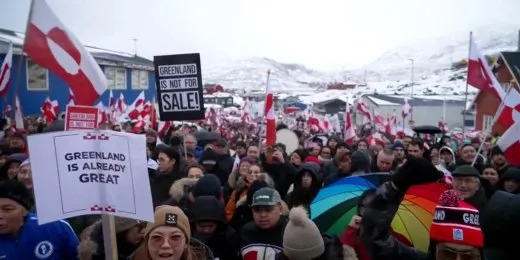
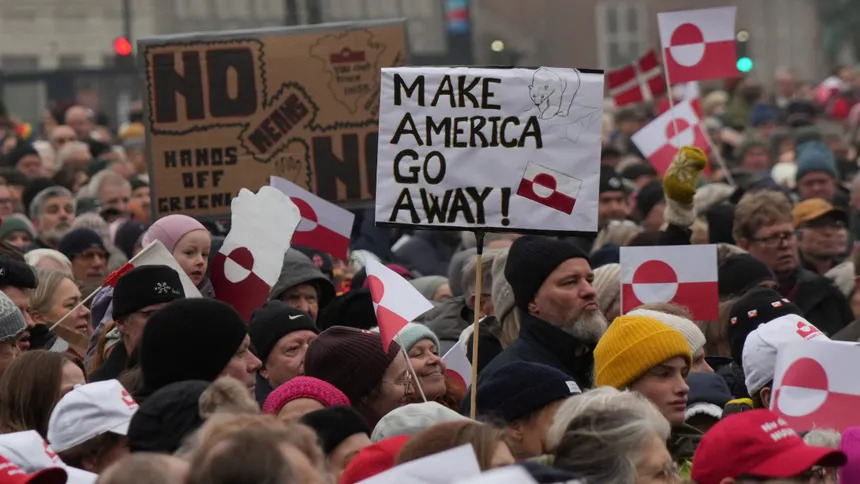
The possibility of US annexation of Greenland is intensely unpopular in that country. Opinion polls cited by the Varian Group conducted in January of 2025 showed 85% disapproval of Greenland becoming part of the US. Globally, the US military has been extremely destructive towards the natural environment. It is likely this will continue if Greenland is under full US control. As in other inter-imperialist rivalries, it is the indigenous people who will be most harmed. The people of Greenland have a right to control their own resources and determine their own future, outside of US and European control.
http://www.redfireonline.com
 Red Fire