
01-11-2025: On Sunday the 26th of October, a fierce storm ripped through South-East Queensland while at the same time a tornado struck west of Melbourne in Victoria. Hail battered parts of western Brisbane and Ipswich, with some hailstones being as large as golf balls. 26 000 homes in South-East Queensland lost power,[1] with some waiting more than a day for it to be restored. Some residents in both regions were shaken by the extremely strong winds, fallen trees and flooding. It was a shuddering start to the “storm season”, with warnings that it has only just started. Yet “storm season” is a euphemism for the almost unmentionable culprit – runaway climate distortion fuelled by more than a century of intense fossil fuel burning. Alongside repeated floods, bushfires, storms and cyclones the extreme weather in Australia and many parts of the world has itself become dangerous.
Net Zero by 2050 ?
The Australian Labor Party (ALP) federal government has trumpeted its signing of Net Zero by 2050 into law. Yet this is a cruel hoax, as this ALP government has given the go ahead to no less than 29 coal mine expansions since 2022, as well as giving the green light to Woodside’s North West Shelf gas mega project, which will unleash an estimated 6.1 billion tonnes of emissions.[2] In any case, 2050 is 25 years away, and may well be too late. Net Zero should refer to achieving an overall balance between greenhouse gas emissions produced and greenhouse gas emissions taken out of the atmosphere. To have any chance of limiting average temperature increases to 1.5 degrees Celsius, many claim that net zero needs to be achieved by 2035, not 2050. Despite this, while there is general support overall for net zero by 2050, the ALP and the Australian Greens basically claim that this means a transition from coal, oil and gas to 100% “renewable energy” (mainly solar and wind power).
It is basically impossible for whole countries, let alone the world, to be powered by solar panels and wind turbines. Other zero carbon (when operating) energy sources, such as nuclear energy, will need to be in an energy mix for a transition to a zero emissions economy. There are positives and negatives associated with nuclear, solar, wind, hydro, geothermal and biomass energy[3] – but advances in nuclear technology in recent decades suggest that it probably should play a major role in a transition away from fossil fuels. Nevertheless, rational decisions should be made on which zero carbon energy sources should be used, in which areas, depending on geographic, population and other factors. While climate denialists deny the need to achieve Net Zero, any attempt by the ALP, backed by the Greens and most ostensible left parties to enforce Net Zero through renewable energy only will cause a divisive backlash. For example, in New South Wales (NSW) and Victoria (VIC) there is large scale opposition to the impacts of wind farms and the Australian Energy Market Operator’s plan to install 10 000 kilometres of overground transmission lines, clearing pristine bushland in the process.[4]
“Community Consultation”
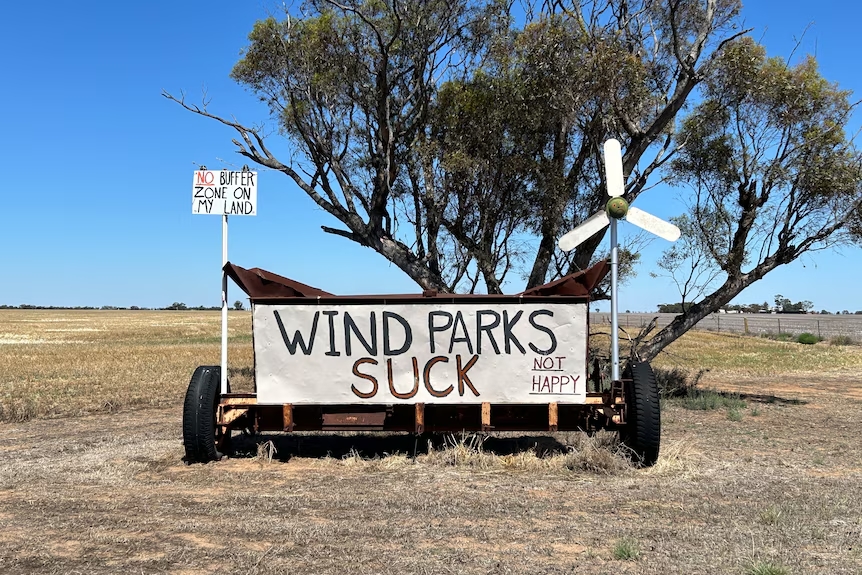
Many in rural and regional areas affected by sprawling projects to set up solar and wind farms are aghast at the way they are treated by renewables corporations. Far from any adequate community consultation, some developers have flat out told residents and landowners that they do not need permission to access their land. Understandably, in response farmers in Western Victoria vowed to lock their gates to stop a major renewable energy link to NSW. In Wollongong, 1000 people assembled to protest a proposed offshore wind farm. The valid concerns are that large scale infrastructure is being rolled out very quickly, most solar and wind projects are being developed in new areas, sparking conflict over land usage, and poor community engagement by renewables project developers.[5] In addition, bitter resentment has arisen between neighbouring farming families when one property owner says no to wind turbines on their property, while the other neighbour says yes and is potentially paid $40 000 per year per turbine. There are reports of farming neighbours whose families have been friends for 100 years who are now no longer even speaking to each other.[6]
The fact is that under capitalism, there never will be adequate “community consultation”, let alone allowing working people to have a say over what developments, renewable energy or otherwise, take place. The profits of giant corporations come first, second and last, even if they are installing a form of zero carbon energy. Neither will they be concerned about how much native forests or untouched environments are clear felled by their immense projects. The ALP government will not be concerned either, as a party committed to a declining capitalist economy – but they will do so to claim false environmental credentials. In turn, parties such as the Greens and their attendant “socialist” adjuncts will be unlikely to raise their voice, given their ideological commitment to 100% renewable energy. This sets up a perfect storm for climate denialists and conservative political parties to cash in.
Rational decisions need to be made about which zero carbon energy sources are used, in which areas, and in which proportion. Yet for this to occur, all energy production and transmission need to be in public hands. A capitalist market is incapable of doing this, no matter how regulated. The socialistic People’s Republic of China (PRC), though bureaucratically deformed, has made giant strides towards a transition to Net Zero. Its development of solar, wind, nuclear energy and electric vehicles is leaving the West in the dust. However imperfect, the PRC demonstrates that the potential to transition to Net Zero is possible, and catastrophic climate collapse may be averted. The pre-requisites, however, are public ownership of the major means of production and a planned economy. Capitalism is driving us towards climate peril, but socialism contains the possibility of a safe climate for generations to come.
Workers League
E: workersleague@protonmail.com
[1] www.cnewsliveenglish.com/news/37348/fierce-storms-batter-queensland-and-victoria-leaving-thousands-without-power-and-residents-shaken-tt (29-10-2025)
[2] www.thenewdaily.com.au/life/science/environment/2025/01/12/labor-coal-mines (29-10-2025)
[3] www.energy-and-electricity.com/renewable-vs-non-renewable-energy-a-comprehensive-comparison/ (29-10-2025)
[4] www.thetimes.com.au/world/28236-do-we-want-a-wind-farm-outside.. (29-10-2025)
[5] https://www.thenewdaily.com.au/life/science/environment/2025/04/10/renewables-opposition-regional-australia (29-10-2025)
[6] www.abc.net.au/news/rural/2025-02-23/renewable-energy-projects-divide-farming-communities/104740690 (29-10-2025)
Image: Many people in regional Victoria are aghast at renewables projects running roughshod over their land and local communities, with little or no consultation and agreement. Image from http://www.abc.net.au
 Red Fire